
Physical Therapy for Runner’s Knee
It's been a while since my series on Running Injuries. Part of the reason, if I'm honest, is that this next problem hits close to home. Runner's Knee, or Patellofemoral Pain or Kneecap Pain, is both one of the most recurrent and common types of pain and the one that I've personally dealt with most consistently. I have plenty to say about this condition, and this won't be my first post on it to say the least.
Unlike a stress fracture or tendinopathy, there are no consistent structural changes associated with this issue. That, coupled with its increased prevalence in females, may have led to a tradition of the condition being dismissed as "in the head" of the person experiencing it. More and more research, however, shows that it's not only common but that our treatments often aren't as effective as for other conditions.
My own experience has been less like recovery from an injury such as a bone stress injury or a cut on the arm, and more like ongoing management of a persistent condition. There are times that goes well, and times that it doesn't — but reframing the pain as something to manage rather than something to cure has shaped my approach to rehab. The human body is often not like a car, where a replacement part totally solves the issue at hand; instead, it's like tending to a plant — keep up the care and it flourishes, let up and it starts to wither.
Why exactly does patellofemoral pain become so persistent? Again, history gives a clue: traditionally more female-oriented conditions are often understudied and taken less seriously. There is a large discrepancy in research funding for PFP compared with other knee conditions — for example, knee osteoarthritis has generated over 14,000 indexed papers in the last 20 years, compared to only 1,500 for PFP, despite PFP having far higher incidence rates. But lifestyle and biomechanics may play more of a role as well, only not in the way initially thought. We now know that altered foot and ankle biomechanics are not consistently observed in people with PFP, and attempts at "correcting" patellar tracking show inconsistent benefits if any.
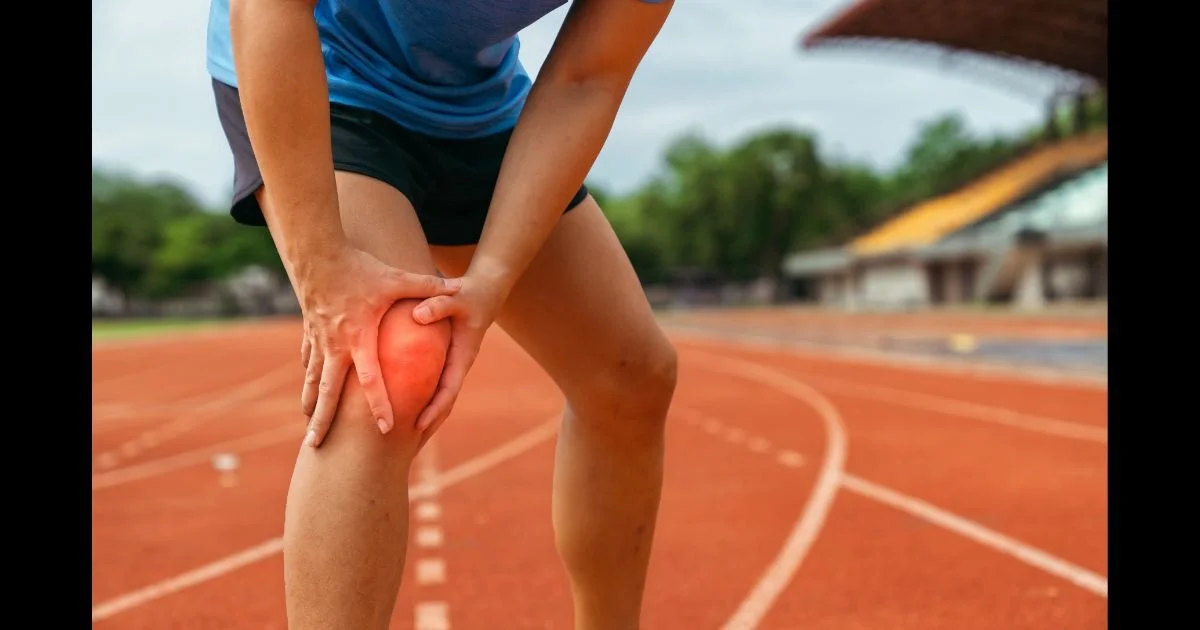
The common distribution of PFP is right around the kneecap.
What’s causing it? We don’t quite know… in fact, we don’t even know what structure is hurting!
But the kneecap does experience outsize forces compared to the rest of the body due to its inherent function as a pulley. The patella's primary purpose is to serve as a mechanical pulley for the quadriceps, changing the direction of the extension force throughout the knee's range of motion — without it, you literally could not straighten your knee against any resistance, let alone run or jump. At rest, some of that force remains when the knee is bent. Under normal circumstances, that doesn't matter — your body can handle it. But if there's heightened sensitivity there, your knee isn't resting even when you sit in a chair. The only other structure that's true of is the lumbar spine — another area with high rates of chronic and recurrent pain (but one with more research behind it).
In my opinion, runner's knee is a misnomer — the condition might better be known as sitter's knee or squatter's knee. Kneecap pain seems fair as the most all-encompassing (there's strong evidence that the pain arises not from the cartilage of the patellofemoral joint itself, which is aneural, but from surrounding innervated tissues including the subchondral bone, infrapatellar fat pad, synovium, and retinaculum). In any case, the fundamental issue seems to be overload and/or under-recovery compounded by difficulty offloading the joint.
When I treat people with severe kneecap pain, movement has become something they deeply fear — especially kneeling and squatting — but even the usually innocuous act of sitting, and along with it recovery, has been stolen. Calming the nervous system and restoring safety of movement is that much more important in these individuals.
If this sounds like you or someone you know, I provide physical therapy for runners in Arlington, VA with an emphasis on treating the whole ecosystem — not just the body part. You can contact me below to set up a chat.
