

Video Running Gait Analysis in Arlington, VA
Running Gait Analysis: Understanding How You Run, Not Just Finding What's Wrong
Running gait analysis has become increasingly popular in the world of running physical therapy. The premise makes sense: if we can identify something about the way you run that contributes to pain, inefficiency, or excessive loading, perhaps we can make a change that helps you run better. But there's a potential problem with this approach. We can become so focused on identifying what looks "wrong" that we lose sight of what actually matters: whether a particular movement pattern is meaningful for the individual runner in front of us.
I think there's a lot of value in running gait analysis, but I also think there's a lot of nuance that gets lost when we start labeling normal variations in human movement as faults that need to be corrected.
Why Analyze Running on a Treadmill?
One of the first questions I get about running gait analysis is why I use a treadmill rather than simply having someone run outside. After all, most runners spend the majority of their time running overground, so wouldn't it make more sense to analyze them in their natural environment?
There's a reasonable argument for this, but I believe treadmill analysis offers several advantages, particularly when we're trying to understand the mechanics of running.
The first is consistency. When running overground, speed can fluctuate from stride to stride, and even subtle changes in pace can influence the way we move. A treadmill allows us to control speed and maintain a relatively consistent running environment. This makes it easier to identify movement patterns and compare changes over time.
The second is the ability to collect repeated observations. Rather than relying on a few strides as someone passes a camera, we can observe multiple consecutive strides from different angles. This is particularly useful when trying to distinguish a consistent movement pattern from the natural variability that occurs with running.
It's worth acknowledging that treadmill running isn't identical to overground running. A systematic review and meta-analysis of 33 studies involving nearly 500 runners found that most biomechanical measures were relatively comparable between treadmill and overground running, but some differences did exist. These included differences in foot position at initial contact, knee mechanics, and vertical movement of the pelvis [1]. Familiarity with treadmill running, belt speed, and the characteristics of the treadmill itself can all influence the results.
So, I wouldn't argue that treadmill analysis is necessarily a perfect representation of how you run outside. Rather, it provides a controlled environment in which we can make meaningful observations. If a particular finding seems important, we can also consider how it translates to your actual running environment.

What Are We Looking For? Sagittal and Frontal Plane Analysis
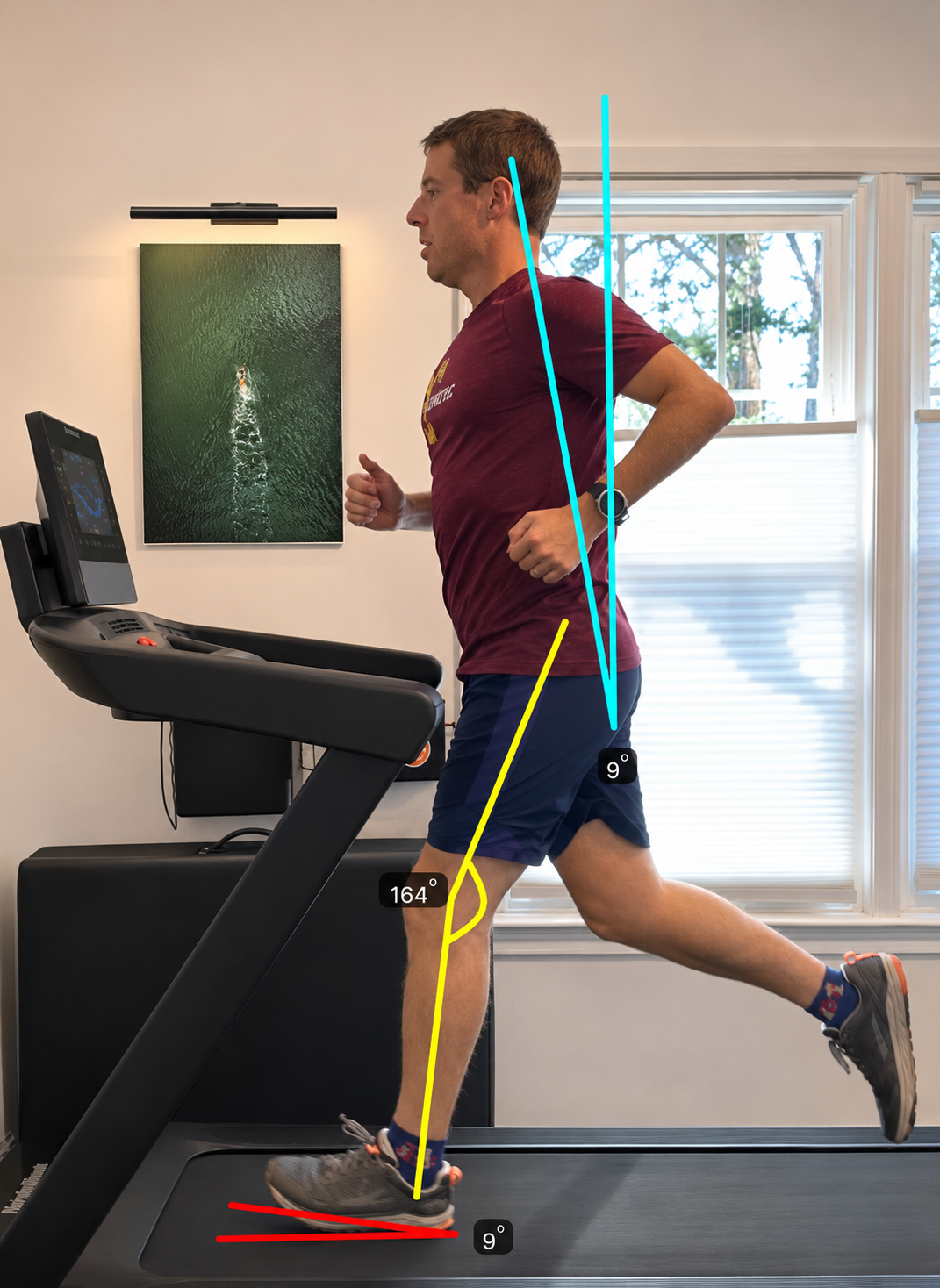
When analyzing running mechanics, I generally think about movement in two primary planes: the sagittal plane (looking at someone from the side) and the frontal plane (looking at someone from the front or back).
Each provides a different perspective, and neither tells the whole story.
1. Sagittal Plane Analysis: Looking From the Side
The sagittal plane is where we can observe several of the more commonly discussed running mechanics. These include:
Foot strike and overstriding: Where does the foot contact the ground relative to the body? Is the runner reaching excessively forward with the lower leg, or landing relatively close to their center of mass?
Knee mechanics: How much does the knee bend during stance, and how does it move through the loading and propulsion phases?
Hip extension: Is there adequate hip extension during late stance, or does the runner demonstrate a relatively limited range of motion?
Trunk position: Does the runner maintain a relatively consistent forward lean, or is there excessive movement through the trunk?
Vertical displacement: How much does the runner move up and down with each stride?
One of the most common things I see discussed in this context is overstriding. The idea is that reaching too far forward with the foot can increase braking forces and potentially contribute to excessive loading. There's some biomechanical rationale here, and changing stride length or cadence can influence certain loading variables. But it's important to distinguish between something that changes a biomechanical measurement and something that actually causes injury.
For example, increasing step rate by a modest amount can reduce stride length and alter loading patterns at the knee and ankle. A 2022 systematic review of gait retraining found moderate-certainty evidence that step-rate interventions can increase cadence and reduce average vertical loading rates [2]. That's useful information, particularly when working with someone who has a specific injury or loading concern. It doesn't mean that every runner with a relatively low cadence is doing something wrong.
Similarly, there's nothing inherently problematic about being a rearfoot striker, midfoot striker, or forefoot striker. These are simply different ways of distributing the demands of running. Changing someone's foot strike can also shift some of those demands elsewhere. A runner who transitions from a rearfoot to a forefoot strike, for example, may reduce certain knee loading measures while increasing demands on the calf and Achilles tendon.
The question isn't necessarily which pattern looks best. It's whether the pattern makes sense given the runner's symptoms, goals, training history, and physical capacity.
2. Frontal Plane Analysis: Looking From the Front and Back
The frontal plane provides a different set of observations, particularly regarding how the pelvis, hips, knees, and feet move relative to one another.
Some of the common things we look at include:
Hip adduction: Does the thigh move inward relative to the pelvis during stance?
Pelvic drop: Does one side of the pelvis drop relative to the other during single-leg support?
Knee position: Does the knee move inward or outward relative to the foot and hip?
Step width: Does the runner demonstrate a relatively narrow or wide base of support, or a crossover running pattern?
Trunk movement: Is there excessive lateral movement or a noticeable shift of the trunk over the stance leg?
Side-to-side differences: Are there meaningful differences between the left and right sides?
These are often the movements that get labeled as "weak glutes," "dynamic knee valgus," or poor hip stability. While these terms can describe what we're observing, they don't necessarily explain why it's happening.
For example, a runner who demonstrates pelvic drop and increased hip adduction might have some limitations in hip strength or capacity. But the same movement could also be influenced by running speed, fatigue, anatomy, stride width, or simply the way that individual has learned to run.
We also need to be careful about assuming that symmetry is always the goal. Some degree of asymmetry is present in many healthy runners. A 2023 study examining running biomechanics found that small side-to-side differences in joint motion were common, even among runners without a history of injury [3]. The presence of asymmetry, by itself, doesn't establish that something needs to be corrected.
Common Running "Faults": What Actually Matters?
There are a number of movement patterns that commonly get identified during gait analysis. I think it's useful to understand what these patterns are, but equally important to understand their limitations.
Here are a few of the more common ones:
Overstriding: Landing with the foot relatively far in front of the body's center of mass. This can increase braking forces and influence loading patterns, but isn't automatically problematic in an asymptomatic runner.
Excessive hip adduction or pelvic drop: Often associated with reduced hip control or strength, but these movements aren't direct measures of glute strength and don't necessarily indicate pathology.
Dynamic knee valgus: An inward movement of the knee during stance. This can be relevant in certain clinical contexts, but the visual appearance of knee valgus alone doesn't tell us whether someone is at risk for injury.
Crossover gait: Running with a relatively narrow step width, sometimes with the feet crossing the body's midline. This may be worth investigating in someone with particular symptoms or loading concerns, but there isn't a universal ideal step width.
Excessive vertical oscillation: Moving up and down more than might be necessary. This can influence running economy, but there's no single ideal amount of vertical movement for every runner.
Excessive pronation: A common target of gait analysis and footwear recommendations. Foot pronation is a normal part of running, and seeing a foot pronate doesn't automatically mean that it's excessive or contributing to an injury.
The common thread here is that none of these observations should automatically lead to a prescription for correction.
Does the Way You Run Predict Whether You'll Get Injured?
This is probably the most important question to address, and it's where I think we need to be particularly careful about how we interpret gait analysis.
There's a tendency in physical therapy to assume that if we can identify a movement pattern that looks different from what we consider ideal, we've found a potential cause of someone's injury. The problem is that the research doesn't really support such a straightforward relationship.
In a 2023 systematic review and meta-analysis, researchers examined 82 studies involving more than 5,400 runners to investigate whether specific biomechanical variables were associated with running-related injuries [4].
Of the many biomechanical variables examined, only peak hip adduction demonstrated a statistically significant association with injury in the meta-analysis. Even that finding was heavily influenced by two studies from the same research group.
The authors' overall conclusion was that there is minimal evidence supporting a relationship between alterations in running biomechanics and running-related injuries.
That's not to say biomechanics don't matter. Rather, it highlights the difficulty of using a snapshot of someone's running mechanics to predict what will happen to them over the next several months.
Consider two runners who demonstrate very similar running mechanics. One may develop Achilles tendinopathy, while the other runs 50 miles per week without any issues. Why?
Because injury isn't simply a consequence of how we move. It's influenced by the interaction between the loads we experience and our ability to tolerate those loads. Training volume, intensity, recovery, sleep, stress, previous injury, and tissue capacity all contribute to that equation.
The same movement pattern can be perfectly tolerable for one runner and problematic for another.
And this is where I think gait analysis is most useful: not as a screening tool to identify everyone who might get injured, but as one piece of a much larger clinical picture.
What Do We Actually Do With the Results?
My goal with running gait analysis isn't to give someone a list of things they're doing wrong. It's to identify whether there are meaningful opportunities to improve how they're running, particularly in the context of an existing injury, recurring symptoms, or a specific performance goal.
Sometimes that means working on cadence, modifying stride length, or experimenting with a different foot-strike pattern. Other times, it means identifying a strength or capacity limitation that we can address through targeted exercise.
And sometimes, the most valuable finding is that there's really nothing about someone's running mechanics that needs to change.
I think that last point is important. There are plenty of runners who have spent years worrying about their pronation, their knee position, or the fact that one foot lands slightly differently than the other. If those things aren't contributing to symptoms or limiting performance, I'm not convinced they deserve the attention they often receive.
We also need to recognize that changing someone's running mechanics isn't necessarily a free intervention. A change that reduces loading in one area can increase it somewhere else. If we change a runner's foot strike, for example, we may shift some of the demands from the knee toward the calf and Achilles. If we increase cadence, we may change the distribution of loading across multiple joints. These changes need to be introduced thoughtfully, particularly in someone who is already dealing with an injury.
Ultimately, the goal isn't to create the perfect-looking runner. It's to help someone find a way of running that allows them to continue doing what they enjoy, while building the capacity to tolerate the demands they're placing on their body.
Running Gait Analysis in Arlington, VA
If you're dealing with a persistent running injury, struggling to make sense of conflicting advice about your running mechanics, or simply curious about whether there's room to improve your running efficiency, a gait analysis can be a useful starting point.
I provide individualized running gait analysis as part of my physical therapy services for runners and triathletes in Arlington, VA. We'll look at your running mechanics from both sagittal and frontal plane perspectives, discuss what we're seeing, and determine whether any of those findings are actually meaningful for you.
Most importantly, we'll put those observations into context with your injury history, training, goals, and physical capacity.
If you'd like to learn more or schedule a running gait analysis, reach out. I'd love to chat.
References and supporting evidence
These are the primary research papers I'd use to support the article. I've prioritized systematic reviews and meta-analyses rather than relying on individual studies wherever possible.
1. Van Hooren B, et al. (2020). Is Motorized Treadmill Running Biomechanically Comparable to Overground Running? A Systematic Review and Meta-Analysis of Cross-Over Studies. Sports Medicine. Read the full article .
2. Doyle E, et al. (2022). The Effectiveness of Gait Retraining on Running Kinematics, Kinetics, Performance, Pain, and Injury in Distance Runners: A Systematic Review With Meta-analysis. Journal of Orthopaedic & Sports Physical Therapy. Read the research .
3. Kinematic and muscle force asymmetry in healthy runners: How do different methods measure up? (2023). Read the research .
4. Are alterations in running biomechanics associated with running injuries? A systematic review with meta-analysis. (2023). Brazilian Journal of Physical Therapy. Read the full open-access review .
5. Anderson LM, et al. (2022). What is the Effect of Changing Running Step Rate on Injury, Performance and Biomechanics? A Systematic Review and Meta-analysis. Read the research .
6. Risk factors for running-related injuries: An umbrella systematic review. (2024). Journal of Sport and Health Science. Read the full open-access review .