
"So should I be biking more while I'm hurt?"
This is one of the eternal questions that I hear when working with injured runners (injured swimmers usually ask if they should be running). The answer is, for the most part, no.
I understand the impulse to want to maintain fitness. When we work towards a goal as endurance athletes, we track our fitness over time and build up something that we feel proud of. The idea of an injury throwing a wrench in the mix and derailing what we’ve built is distressing. But I believe that losing fitness when you’re injured is actually an important part of the recovery process, and there’s a way to reframe this loss as a gain.
Losing fitness helps to set safety rails

When you maintain your cardiovascular fitness through an alternative means of exercise while injured, you’re sending a conflicting signal to your body: the engine is ready, but the vehicle is not. In one study, Achilles tendon stiffness dropped off after only a month off (Kubo et al., 2012). A month spent cross-training on the bike is enough to decrease tendon stiffness - and if your aerobic capacity stays elevated, when you get back to running you’ll be doing so with an achilles that’s not up to the task.
When you allow your engine to decrease in capacity, that mismatch goes away: suddenly, an appropriate exertional effort matches much more closely with what your irritated tissue can handle. Run based on effort, not your past pace, and you’ll be able to tolerate much more.
Peak fitness isn’t meant to be maintained year-round

At the top level of endurance sports, athletes go through cycles of fitness. Build, peak, recover, repeat. The time they take off after high-level efforts isn’t a waste: it allows the body and mind to absorb the load of the next training block (García-Palláres et al., 2009).
Many recreational endurance athletes don’t periodize their training like the pros: exercise and performance aren’t a job to most of us, they’re a way to manage our stress and stay sane in life. That makes the idea of slowing down less palatable - but it’s often exactly what we need.
Injury and pain are often a signal that relative rest and recovery are exactly what is needed: after two heel stress fractures cost her a season, elite U.S. marathoner Jordan Hasay said, "I just tried to see it as a good rejuvenation" (Track & Field News, 2019).
Learning restraint is a skill
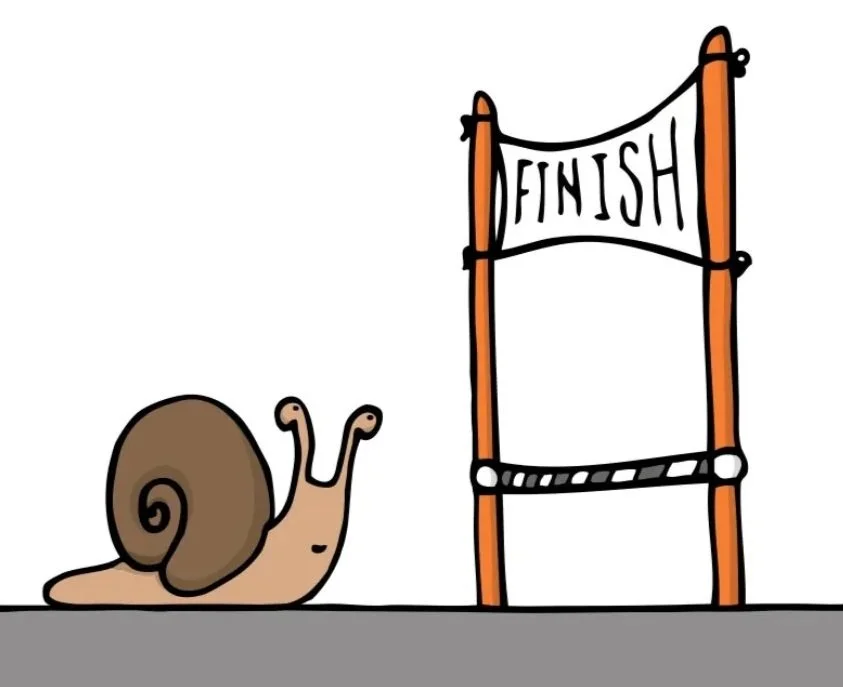
The number one rule of endurance sports is to protect consistency of training. The athletes who improve the most aren’t the ones who push hard in a given session, they’re the ones who show up day after day to put in a little bit of effort. Consistency is crucial, and building consistency depends on restraint.
When people are slowed down by an injury, it provides them with an incredible opportunity to work on holding back and thus beginning to learn the importance of consistency. I’ve seen many athletes come back from injury better than they were before after learning this lesson. When we’re injured and try to maintain fitness through cross training, it skips over this lesson altogether: instead of slowing down, we stay at the same frenetic pace as usual.
How much fitness am I losing?
Less, and more slowly, than you fear. A classic study followed endurance athletes who stopped training completely. Their VO2max dropped about 7% in the first three weeks, then leveled off about 16% below where they started by week eight. Even after 12 weeks of doing absolutely nothing, they were still fitter than people who had never trained (Coyle et al., 1984). Most of us won’t do nothing when we have pain, so our losses will be even smaller; additionally, your fitness will come back faster than someone who has never trained (Lepers et al. 2024).
What should I do?
Move because it feels good, not to protect a number. A relaxed swim or bike ride that leaves you feeling better is great.
Put your energy into the injured area. The most useful work is usually rehab that gradually loads the painful tissue so it can handle running again.
Come back by effort, not by pace. Let your new easy pace be easy. Your old splits will return when your body is ready.
Treat this as a skill-building block. Practice stopping before you have to. That habit is worth more over your lifetime than the fitness you’ll lose.
Dr. Greg Lemek, PT, DPT, OCS is the founder of Persist Physical Therapy, located inside Strive Fitness Studio at 5130 Wilson Boulevard, Arlington, VA 22205. Persist PT specializes in working with endurance athletes and active adults who want non-rushed, one-on-one care.
🌐 Homepage
